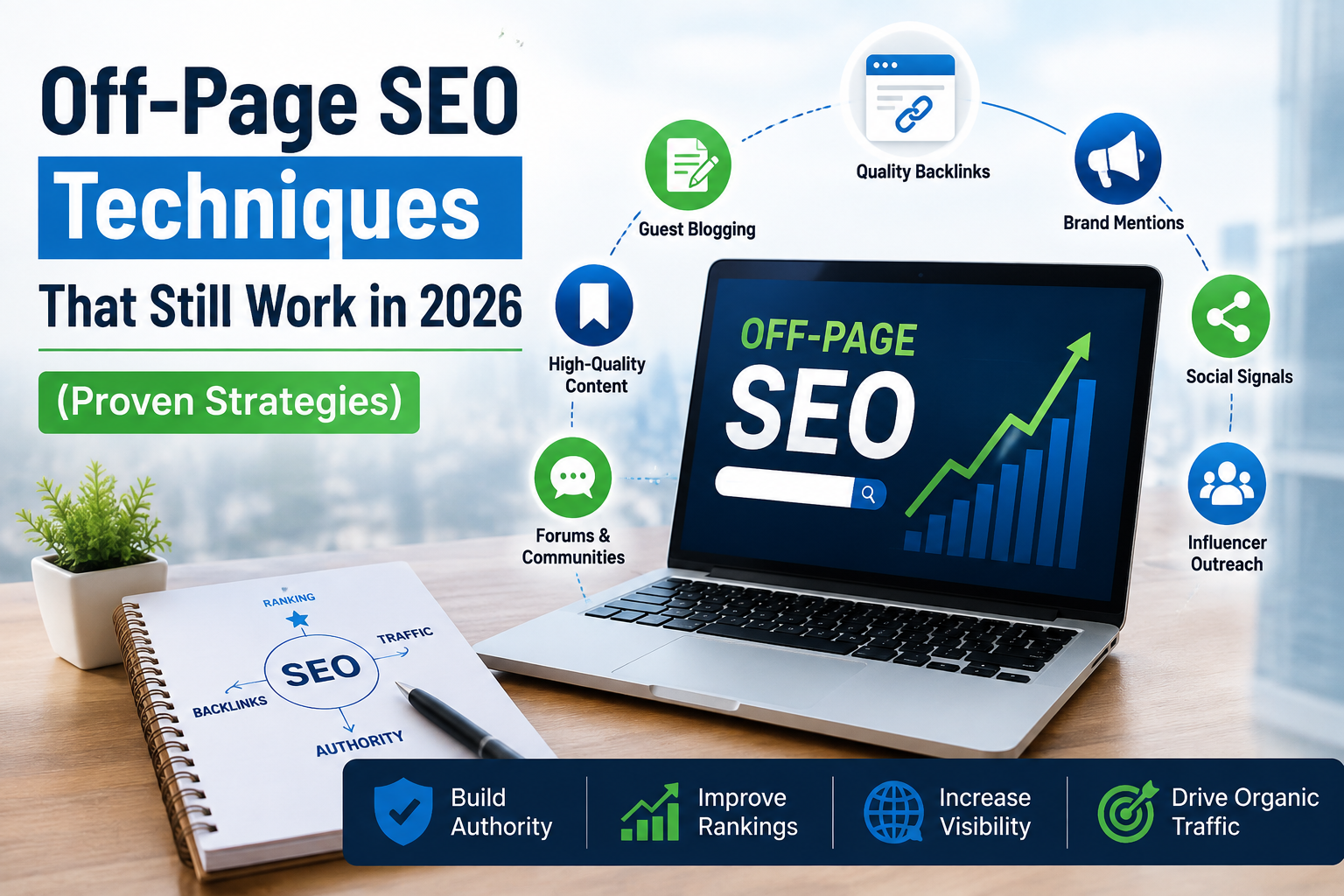
Discover proven off-page SEO techniques that still work in 2026. Learn link building strategies, backlink tips, and a free checklist to rank higher on Google.
Why Off-Page SEO Still Decides Who Wins on Google
You can write the best content in the world. You can fix every technical error on your site. But if nobody outside your website talks about you, links to you, or mentions your brand, Google has no real reason to trust you.
This is the problem most business owners in Bangalore and beyond run into. They pour money into on-page SEO, keywords, meta tags, page speed, and still don't rank. The missing piece is usually off-page SEO.
The good news? Off-page SEO techniques still work in 2026. They've just changed shape. Spammy link building is dead. Trust, relevance, and real digital PR are what move the needle now.
In this guide, you'll get a complete, practical breakdown of off-page SEO, what it is, why it matters, and the exact techniques that are helping businesses build authority and rank higher this year.
What Is Off-Page SEO?
Off-page SEO refers to all the actions taken outside your own website to improve its position in search engine results. Unlike on-page SEO (which focuses on content, keywords, and site structure), off-page SEO is about building your website's reputation, authority, and trustworthiness across the internet.
In simple terms: on-page SEO tells Google what your page is about. Off-page SEO tells Google why your page deserves to be trusted.
Common off-page SEO activities include:
- Earning backlinks from other websites
- Getting brand mentions across the web
- Building a presence on social media
- Guest posting on relevant blogs
- Getting listed in local business directories
- Earning reviews and citations
Why Off-Page SEO Still Matters in 2026
Search engines like Google have become smarter at understanding content quality directly from a page. But that hasn't reduced the importance of off-page signals, if anything, it's increased it.
Here's why:
- Backlinks remain a core trust signal. Google has repeatedly confirmed that links and content are among its top ranking factors. A page with strong, relevant backlinks is treated as more credible than one without any external validation.
- AI-generated content has flooded the web. With more low-effort content online, Google leans harder on real-world signals, brand mentions, reviews, and quality backlinks, to separate trustworthy sites from generic ones.
- E-E-A-T is now central to rankings. Experience, Expertise, Authoritativeness, and Trustworthiness can't be built through on-page tricks alone. Off-page SEO is how you prove authority to Google and to real users.
- Local competition has intensified. For businesses targeting cities like Bangalore, local citations, reviews, and location-based backlinks are often the deciding factor between page 1 and page 3.
If you're serious about ranking, off-page SEO isn't optional, it's foundational.
Off-Page SEO Factors That Influence Rankings
Before jumping into techniques, it helps to understand the specific off-page SEO factors search engines evaluate:
- Backlink quality – relevance, authority, and trustworthiness of linking domains
- Backlink diversity – links from different domains, not just one source repeated
- Anchor text relevance – natural, varied anchor text (not over-optimized)
- Domain authority of referring sites
- Brand mentions – even unlinked mentions carry weight
- Social signals – shares, engagement, and visibility
- Local citations – NAP (Name, Address, Phone) consistency across directories
- Content engagement off-site – how people talk about and reference your content elsewhere
Understanding these factors makes it much easier to prioritize your off-page SEO checklist (covered later in this guide).
Off-Page SEO Techniques That Still Work in 2026
Let's get into the actual strategies. These are the off-page SEO techniques delivering real results right now, not outdated tactics that get flagged by Google.
1. Digital PR and Newsworthy Content
Digital PR is one of the strongest link building strategies 2026 has to offer. Instead of asking for links, you create something worth writing about, original research, industry data, or a unique angle on a trending topic, and pitch it to journalists and bloggers.
Example: A Bangalore-based fintech startup published a small survey on UPI usage trends among Gen Z. Local business publications picked it up, resulting in several high quality backlinks from news sites, links that would be nearly impossible to get through cold outreach alone.
2. Guest Blogging on Relevant, Authoritative Sites
Guest posting isn't dead, low-quality, mass-produced guest posting is. In 2026, the technique still works when you:
- Target sites genuinely relevant to your industry
- Write original, valuable content (not recycled articles)
- Avoid exact-match anchor text stuffing
- Focus on 5–10 quality placements over 50 low-value ones
This remains one of the most reliable backlink building techniques for businesses that want steady, compounding authority growth.
3. Web 2.0 Submissions (Done the Right Way)
Web 2.0 platforms, like Medium, Tumblr, and niche blogging platforms, can still support your off-page strategy when used correctly, not spammed. They work best as supporting content that drives brand visibility, referral traffic, and occasional link equity, rather than as your primary link source.
For a full breakdown of platforms and best practices, check out this detailed guide: Web 2.0 Submission Sites.
4. Local Citations and Directory Listings
For businesses targeting a specific city, local citations are one of the highest-ROI off-page seo activities available.
Steps to do this correctly:
- List your business on Google Business Profile, Justdial, Sulekha, and other India-specific directories
- Keep your Name, Address, and Phone number (NAP) identical everywhere
- Choose relevant local categories
- Add location-specific keywords naturally in your business description
A Bangalore digital agency that cleaned up inconsistent NAP data across 20+ directories saw noticeably improved local pack visibility within a few months, a simple fix with a real impact.
5. Influencer and Industry Expert Outreach
Partnering with niche influencers or subject-matter experts for interviews, quotes, or collaborations builds both backlinks and credibility. Even a single mention from a respected voice in your industry can drive referral traffic and signal relevance to search engines.
6. Social Media Signals and Community Engagement
While social shares aren't a direct ranking factor, they influence off-page SEO indirectly by:
- Increasing content visibility and reach
- Driving traffic that can lead to organic backlinks
- Building brand recognition, which supports E-E-A-T
Active participation in relevant LinkedIn groups, X (Twitter) threads, and industry communities helps your brand get discovered, and discovered brands get linked to.
7. Forum and Q&A Participation (Reddit, Quora)
Genuinely helpful answers on Reddit and Quora build topical authority and can drive qualified traffic. The key is value first: answer the question thoroughly, and only link to your site when it's truly relevant, not in every response.
8. Broken Link Building
Find broken links on relevant, authoritative websites and suggest your content as a replacement. It's a win-win: the site owner fixes a dead link, and you earn a relevant, high-quality backlink.
9. Podcast and Video Guest Appearances
Being featured on industry podcasts or YouTube channels earns brand mentions, backlinks from show notes, and audience trust, all valuable off-page SEO signals that are harder for competitors to replicate.
How to Build High-Quality Backlinks: A Step-by-Step Approach
If you remember nothing else, remember this simple process for earning high quality backlinks:
- Audit your current backlink profile – know what you have before building more
- Identify link-worthy content gaps – create content worth linking to (data, guides, tools)
- Build a target list – find sites relevant to your niche and location
- Personalize outreach – generic emails get ignored; specific, relevant pitches get replies
- Track and measure – monitor referring domains, not just link count
- Disavow toxic links periodically – protect your domain from spam link damage
Off-Page SEO Checklist for 2026
Use this quick off-page seo checklist to audit your current strategy:
- Claimed and optimized Google Business Profile
- Consistent NAP across all directories
- At least 3–5 high-authority backlinks earned this quarter
- Guest posts published on relevant, niche-specific sites
- Active social media presence with regular engagement
- Brand mentions monitored and tracked
- Toxic/spammy backlinks disavowed
- Reviews actively collected and responded to
- Web 2.0 and supporting content platforms used strategically
Off-Page SEO Examples in Action
Here are a few simplified off-page seo examples to show these techniques in practice:
- A SaaS company earned backlinks by publishing an original industry benchmark report that other blogs cited
- A local restaurant chain improved its Google Maps ranking purely through consistent citation building and review generation
- A Bangalore SEO agency (like Cronbay Technologies) helped a client increase referring domains by combining guest posting, digital PR, and local citations over six months
Common Off-Page SEO Mistakes to Avoid
- Buying links in bulk from low-quality link farms
- Over-optimizing anchor text with exact-match keywords
- Ignoring local SEO citations while chasing national backlinks
- Treating social media as a link source instead of a visibility tool
- Focusing on link quantity instead of relevance and authority
FAQs About Off-Page SEO
1. What is off-page SEO in simple terms?
Off-page SEO is everything you do outside your website to build its authority and trust, mainly through backlinks, brand mentions, and online reputation.
2. What are the top off-page SEO factors in 2026?
Backlink quality, brand mentions, local citations, social signals, and content engagement off-site are the leading factors search engines evaluate.
3. How many backlinks do I need to rank?
There's no fixed number. Quality and relevance matter far more than quantity. A handful of authoritative, relevant backlinks often outperforms hundreds of weak ones.
4. Is guest posting still effective for SEO in 2026?
Yes, when done on genuinely relevant, reputable sites with original content. Mass, low-quality guest posting no longer works and can hurt rankings.
5. Are web 2.0 submissions still useful for SEO?
Yes, as a supporting strategy for visibility and referral traffic, not as your main source of backlinks. Learn more about web 2.0 submission sites here .
6. How long does off-page SEO take to show results?
Typically 3–6 months for noticeable movement, depending on competition, industry, and consistency of effort.
Conclusion: Off-Page SEO Is Still the Trust Engine of Google Rankings
Off-page SEO in 2026 isn't about tricking search engines, it's about earning genuine trust through relevant backlinks, consistent citations, digital PR, and real brand visibility. The techniques that work today reward businesses that focus on relevance and quality over shortcuts.
If you're a business owner, developer, or marketer in Bangalore looking to build real search authority, start with the checklist above, and stay consistent.
Want expert help executing these off-page SEO techniques for your business?
Talk to the SEO Experts at Cronbay Technologies, Bangalore →
.png)