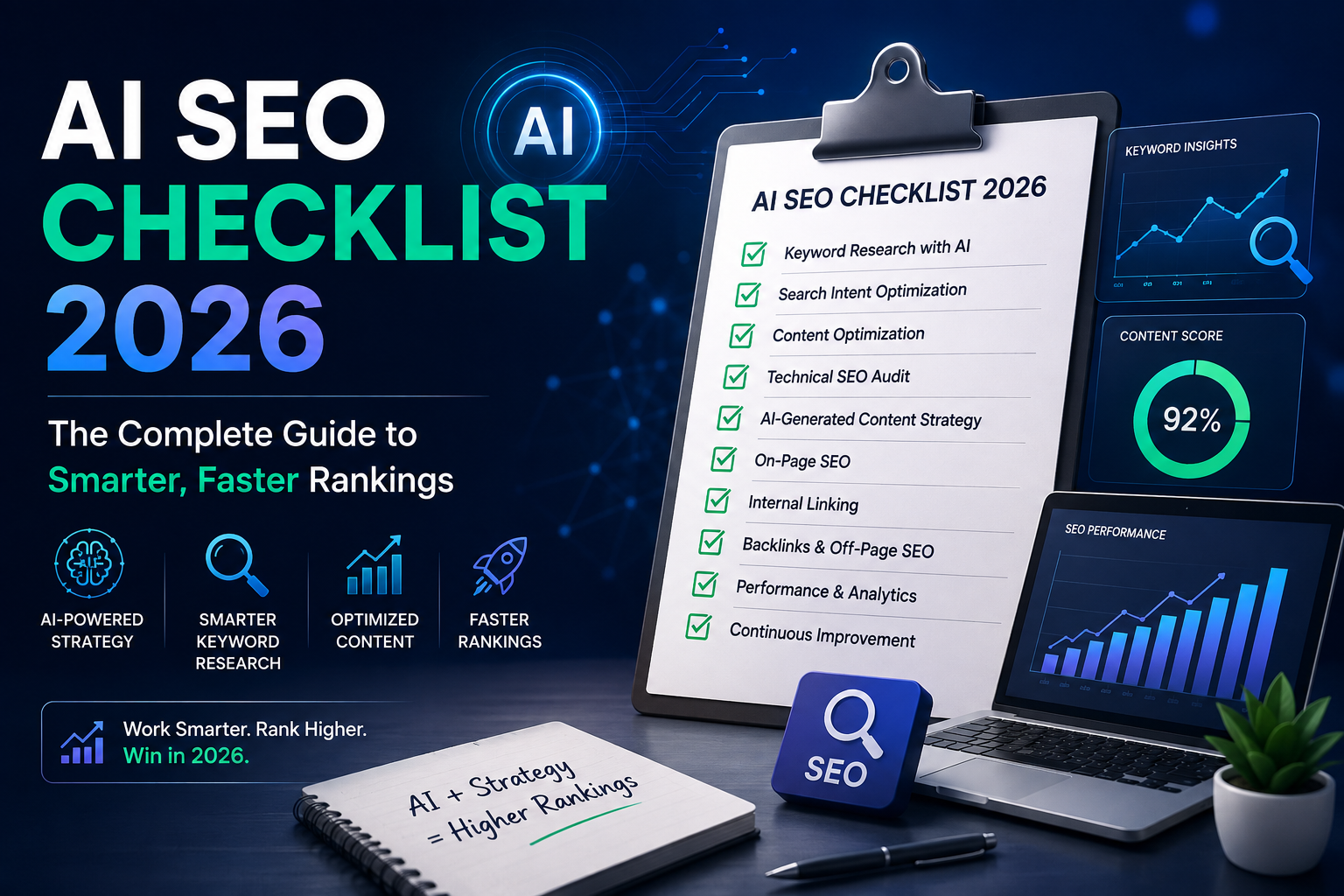
Discover the ultimate AI SEO checklist for 2026. Learn how AI is transforming SEO workflows, tools, and best practices for businesses in Bangalore and beyond.
Introduction
Search engines don't work the way they did two years ago. Google now answers many questions directly on the results page. AI Overviews summarize content before a user even clicks a link. Tools like ChatGPT and Gemini are becoming search destinations of their own.
If your SEO checklist still looks like it did in 2022, you're already behind.
This is where an AI SEO checklist comes in. It's not just a new name for the old process, it's a rebuilt system for how businesses plan, create, and measure content in an AI-driven search world.
In this guide, we'll break down exactly how AI is transforming SEO checklists and workflows, and give you a practical, step-by-step AI-powered SEO checklist you can start using today, whether you run a startup in Bangalore or manage SEO for a global brand.
What Is an AI SEO Checklist?
An AI SEO checklist is a structured set of steps that combines traditional search engine optimization tasks, keyword research, on-page SEO, technical audits, link building, with AI tools and AI-search readiness factors like Answer Engine Optimization (AEO) and Generative Engine Optimization (GEO).
In simple terms, it answers three questions:
- Will search engines understand and rank your content?
- Will AI tools like ChatGPT, Gemini, and Google AI Overviews want to cite it?
- Can your team execute all of this faster, without sacrificing quality?
A modern AI SEO optimization checklist covers both halves of visibility: classic blue-link rankings and the newer "answer box" visibility inside AI-generated responses.
Why Traditional SEO Checklists Fall Short in 2026
Old-school SEO checklists were built for a world where users clicked through ten blue links. That world has changed.
- Zero-click searches now account for a large share of Google sessions, meaning many queries are answered right on the results page without a click.
- AI Overviews have measurably reduced click-through rates for even top-ranking pages, according to large-scale industry studies analyzing hundreds of thousands of keywords.
- A growing share of marketers, well over half in most recent industry surveys, now use AI tools somewhere in their SEO process, from keyword research to content briefs.
A checklist that only tracks keyword density, backlinks, and meta tags misses half the picture. It doesn't check whether your content is structured for AI to extract, summarize, and cite, which is now just as important as ranking in position one.
This gap is exactly why businesses are shifting to an AI-powered SEO checklist that treats AI visibility as a core ranking factor, not an afterthought.
How AI Is Transforming SEO Workflows
AI hasn't replaced SEO, it has changed how SEO gets done, at nearly every stage of the workflow.
1. Keyword Research Gets Faster and Smarter
AI tools now cluster keywords by search intent in seconds, not hours. Instead of manually sorting hundreds of keywords into spreadsheets, AI groups them by topic, funnel stage, and question type, surfacing conversational, question-based queries that match how people actually talk to AI assistants.
2. Content Briefs Are Auto-Generated
Content brief generation is one of the most widely adopted AI use cases in enterprise SEO teams today. AI can pull competitor structures, identify content gaps, and draft an outline in minutes, giving writers a strong starting point instead of a blank page.
3. Technical SEO Audits Run Continuously
AI-powered crawlers flag broken links, slow pages, duplicate content, and schema errors automatically. Instead of quarterly audits, many teams now run always-on technical monitoring.
4. On-Page Optimization Becomes Predictive
AI tools suggest headings, internal links, and semantic keywords based on what's already ranking, while also checking whether content is "extractable" for AI Overviews and chat-based answer engines.
5. Reporting and Analysis Are Automated
AI summarizes ranking changes, traffic shifts, and competitor moves into plain-language reports, cutting analysis time significantly and freeing strategists to focus on decisions instead of data pulling.
Want a workflow built around these exact principles? Cronbay Tech's SEO team in Bangalore builds custom AI-integrated SEO systems for growing businesses.
The AI SEO Checklist 2026: Step-by-Step
Here is a practical AI SEO checklist 2026 you can follow, broken into five phases.
Phase 1: Research
- Use AI to cluster keywords by search intent (informational, navigational, transactional)
- Identify question-based and conversational queries
- Analyze what AI Overviews and chatbots currently cite for your target topics
- Study competitor content gaps using AI-assisted analysis
Phase 2: Planning
- Generate an AI-assisted content brief with headings, entities, and target word count
- Map content to the buyer journey stage
- Decide which pages need AEO-specific formatting (direct answers, definitions, lists)
Phase 3: Creation
- Draft with AI assistance, then edit for accuracy, tone, and brand voice
- Add original data, examples, or expert quotes AI cannot generate on its own
- Structure content with clear H2/H3 headings, short paragraphs, and bullet points
- Write direct, snippet-friendly answers near the top of key sections
Phase 4: Technical & On-Page
- Run an AI-powered technical audit (site speed, crawlability, mobile usability)
- Add schema markup (FAQ, Article, Organization)
- Optimize meta titles and descriptions with primary and secondary keywords
- Check internal linking structure with AI recommendations
Phase 5: Monitoring
- Track both traditional rankings and AI citation visibility
- Use AI reporting tools to summarize weekly/monthly performance
- Refresh underperforming content based on AI-flagged opportunities
AI SEO Optimization Checklist: Best Practices
Beyond the step-by-step process, a few best practices separate teams that succeed with AI from those that don't.
- Always review AI output. Most marketers who use AI content tools still review and edit everything before publishing, and this human check remains essential for accuracy and brand voice.
- Write for extraction, not just ranking. Structure key facts in short, direct sentences near the top of a section so AI systems can quote them cleanly.
- Keep content fresh. Pages cited most often by AI tools tend to have been updated recently, freshness is a real ranking signal in the AI search era.
- Don't abandon E-E-A-T. AI can draft, but experience, expertise, authoritativeness, and trust still come from real people, real data, and real examples.
- Balance automation with strategy. AI speeds up execution, but the strategic decisions, what to publish, why, and for whom, still need human judgment.
This is the core of any solid AI SEO best practices checklist: use AI to move faster, but never remove the human layer of judgment and expertise.
AI-Powered SEO Checklist Tools Worth Knowing
While tool choice depends on budget and team size, most AI SEO workflows in 2026 lean on a mix of:
- AI content and brief generators for outlines and drafts
- AI-enhanced keyword and clustering tools for intent mapping
- Technical SEO crawlers with AI flagging for continuous audits
- AI visibility trackers that monitor citations inside AI Overviews and chat tools
- AI reporting dashboards that turn raw data into plain-language insights
The specific stack matters less than having each phase of the checklist covered, research, creation, technical, and monitoring.
Common Mistakes to Avoid
- Publishing AI drafts without human review — this hurts accuracy and trust
- Ignoring AI Overview visibility while only tracking classic rankings
- Keyword stuffing AI-generated content, which can trigger quality issues
- Skipping technical SEO because AI content "sounds good"
- Treating AI as a one-time tool instead of building it into an ongoing workflow
A Bangalore Business Example
Consider a mid-sized B2B software company in Bangalore. Their old process took a content writer nearly two weeks to research, draft, and publish a single in-depth guide. After rebuilding their workflow around an AI SEO checklist, AI-assisted research, brief generation, and technical audits, the same guide could move from idea to publish-ready draft in a few days, with the writer's time redirected toward original insights, data, and editing for accuracy.
This is the real shift AI brings: not replacing expertise, but removing the repetitive work that used to eat up most of it.
If you want a similar workflow for your business, Cronbay Tech helps Bangalore-based businesses build AI-ready SEO systems from the ground up.
FAQs
An AI SEO checklist is a structured process that combines traditional SEO tasks with AI tools and AI-search readiness steps, covering keyword research, content creation, technical audits, and visibility in AI-generated answers.
AI is speeding up keyword research, content briefs, technical audits, and reporting, while also introducing new priorities like Answer Engine Optimization (AEO), making content ready to be cited inside AI Overviews and chatbot answers.
No. AI speeds up execution, but strategic decisions, original expertise, and quality review still require human judgment. Most marketers using AI content tools continue to review and edit before publishing.
It should cover five phases: research, planning, creation, technical/on-page optimization, and monitoring, with AI supporting each phase rather than replacing the overall strategy.
Not by default. Google doesn't penalize AI-assisted content; it evaluates content on quality, accuracy, and usefulness, regardless of how it was drafted.
Given how fast AI search features evolve, review and update your checklist at least quarterly, and monitor AI citation trends monthly.
Conclusion
AI hasn't replaced SEO, it has rebuilt the workflow around it. From faster keyword research to AI-ready content structuring, a modern AI SEO checklist helps businesses stay visible in both traditional search results and the growing world of AI-generated answers.
The businesses that win in 2026 won't be the ones that avoid AI or the ones that rely on it blindly. They'll be the ones that combine AI speed with real human expertise, exactly the approach behind a solid AI-powered SEO checklist.
Ready to build an SEO strategy that works for both Google and AI search engines?

.png)