Learn what topical authority in SEO really means and how to build it in 2026. A step-by-step strategy for ranking higher on Google and AI search.
Introduction
Google doesn't just rank pages anymore. It ranks sources it trusts on a topic. If your website covers one subject in a scattered, shallow way, you will keep losing rankings to competitors who cover it deeply, from every angle. This is the core idea behind topical authority in SEO, and in 2026, with AI-powered search engines like Google AI Overviews, ChatGPT, and Perplexity choosing which brands to mention, it matters more than ever.
Most businesses in Bangalore and beyond still chase single keywords instead of owning entire topics. They publish one blog post, wait for traffic, and wonder why nothing ranks. The problem isn't the content quality alone, it's the missing topical depth around it.
This guide breaks down exactly what topical authority is, why it decides who wins in search today, and a practical, step-by-step topical authority strategy you can start using this week, whether you're a business owner, a developer building a content system, or a marketer planning next quarter's content calendar.
What Is Topical Authority in SEO?
Topical authority is the level of trust and expertise a search engine assigns to a website for a specific subject area, based on how completely and consistently that site covers the topic.
In simple terms: it's not about ranking for one keyword. It's about becoming the go-to source for an entire subject, so Google trusts you across dozens (or hundreds) of related searches.
A site with strong topical authority typically:
- Covers a subject from beginner to advanced level
- Links its content together in a logical, organized structure
- Gets cited or referenced by other trusted sites
- Consistently publishes accurate, updated information on the topic
- Shows clear expertise through author credentials and real-world detail
Think of two Bangalore-based websites both writing about "digital marketing." One has 5 random blog posts. The other has 60 interlinked articles covering strategy, tools, case studies, local SEO, and industry trends, written by people who clearly know the field. Google will trust the second site far more, even for keywords it hasn't directly targeted yet.
Topical Authority vs. Domain Authority
These two terms get confused often, so here's the difference:
| Topical Authority | Domain Authority |
|---|---|
| Trust in a specific subject | General site strength/popularity |
| Built through content depth and structure | Built mostly through backlinks |
| Topic-specific (can vary by subject) | Site-wide metric |
| Directly tied to search intent matching | Indirectly tied to rankings |
A site can have high domain authority and still rank poorly in a niche topic if it has never built real depth there. This is why topical relevance SEO, matching content closely to what a topic actually requires, often outperforms pure link-building.
Why Topical Authority Matters More in 2026
Search has changed. A few shifts are driving this:
- AI Overviews and chat-based search now summarize answers instead of just listing links, and they tend to pull from sources that already show consistent expertise on a topic.
- Google's helpful content systems reward sites built for real audiences, not sites built around isolated keywords.
- E-E-A-T (Experience, Expertise, Authoritativeness, Trust) has moved from a "nice to have" to a ranking necessity, especially in competitive industries like finance, health, and B2B services.
- Zero-click searches are rising, so brands need to be the trusted answer, not just a ranked link.
This is exactly why topical authority for AI search is becoming a distinct discipline. AI search tools don't just crawl a page, they evaluate whether a domain has demonstrated depth across a subject before deciding to cite or recommend it. A single well-written article rarely earns that trust. A well-structured topic cluster does.
How to Build Topical Authority: A Step-by-Step Strategy
Here is a practical topical authority strategy you can apply, regardless of industry.
Step 1: Choose Your Core Topics (Not Just Keywords)
Start by defining 2–4 broad subject areas your business genuinely serves. A Bangalore-based IT services company, for example, might choose: SEO, web development, and digital marketing, not 50 unrelated keywords.
Ask:
- What do we have real expertise in?
- What do our customers actually search for before buying?
- What subjects can we realistically cover in-depth over the next 12 months?
Step 2: Build a Topic Cluster Model
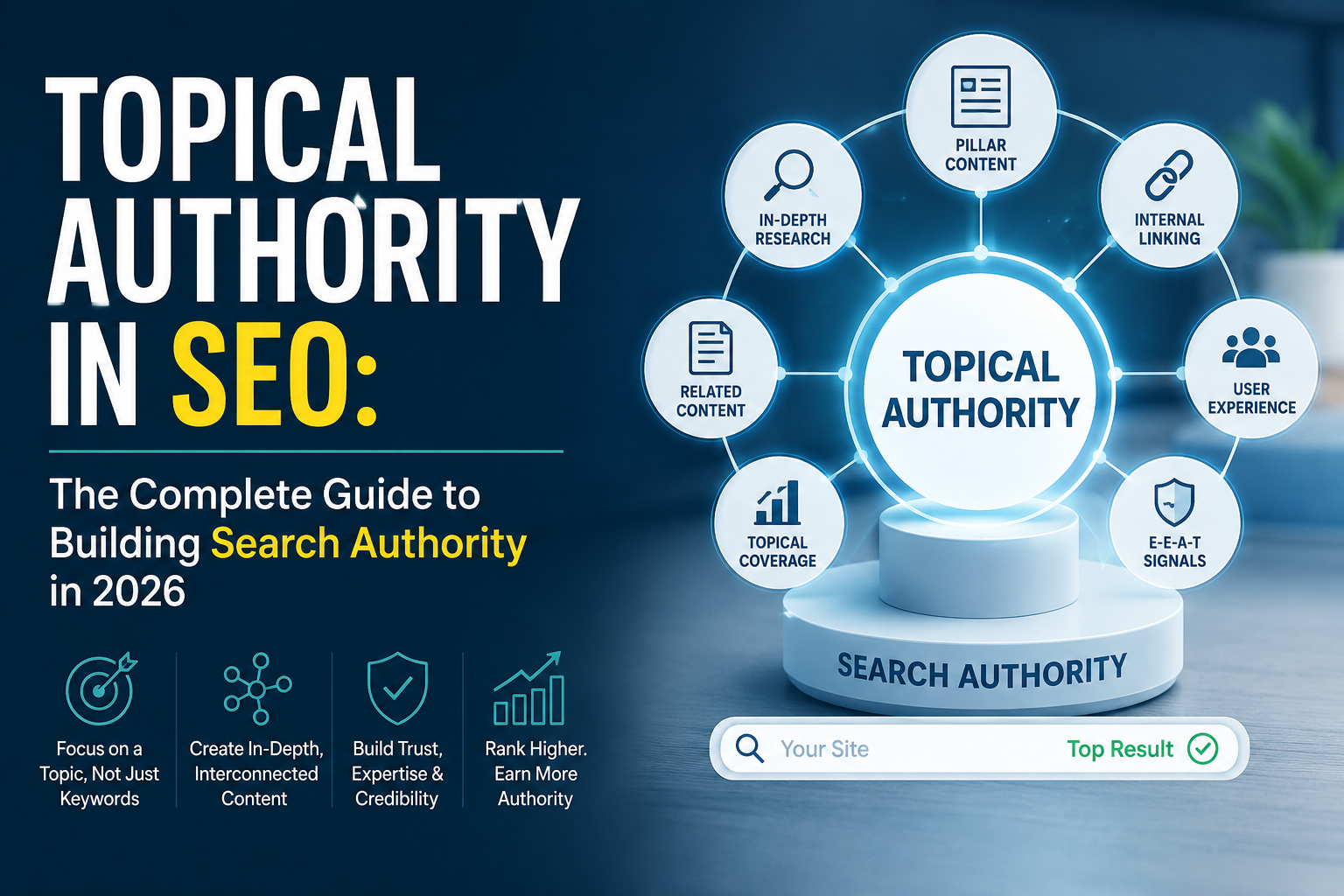
A topic cluster has three parts:
- Pillar page — a comprehensive guide on the core topic (like this one)
- Cluster content — supporting articles on subtopics, questions, and long-tail terms
- Internal links — connecting cluster content back to the pillar page and to each other
This structure signals to Google that your site has organized, complete knowledge of the subject, which is the foundation of how to build topical authority correctly.
Example structure for "SEO":
- Pillar: Topical Authority in SEO (this page)
- Cluster: On-page SEO checklist
- Cluster: Local SEO for Bangalore businesses
- Cluster: Link building strategies
- Cluster: Web 2.0 submission sites for backlinks
Step 3: Perform Topic-Level Keyword Research
Instead of researching one keyword, map out every question, sub-intent, and related term inside your topic. Tools like Google's "People Also Ask," AnswerThePublic, and Search Console query data work well here.
Group these into:
- Informational (what is, how to, why)
- Comparison (X vs Y)
- Transactional (best, hire, buy)
This ensures your content answers real searcher questions instead of guessing.
Step 4: Create Genuinely Deep, Original Content
Shallow, 500-word posts rarely build authority. Aim for content that:
- Answers the question completely on the page
- Includes original insights, examples, or data
- Avoids repeating what's already on page one of Google
- Is reviewed or written by someone with real subject knowledge
This is where expertise, experience, and trust actually show up, not through keyword count, but through depth a competitor's content is missing.
Step 5: Interlink Strategically
Every new piece of content should link to your pillar page and at least 2–3 related cluster articles. This does two things:
- Passes topical relevance signals between pages
- Helps users (and crawlers) navigate your full topic coverage
Step 6: Earn Topic-Relevant Backlinks
Not all backlinks help topical authority equally. A link from a site in your industry carries more topical weight than a generic directory link. Guest posts, digital PR, and web 2.0 submission sites can still support authority building when used correctly, as one part of a diversified link profile, not the whole strategy. (See our detailed guide on web 2.0 submission sites for a practical list.)
Step 7: Update and Expand Content Regularly
Topical authority isn't a one-time project. Revisit your pillar and cluster pages every few months to:
- Add new sections for emerging subtopics
- Update statistics and examples
- Fix outdated information
- Expand thin sections that competitors now cover better
Common Mistakes That Weaken Topical Authority
- Publishing without a content plan — random topics with no cluster structure
- Keyword stuffing instead of topic coverage — repeating a phrase instead of explaining the subject fully
- Ignoring internal linking — leaving related articles disconnected
- No clear author expertise — missing author bios, credentials, or real-world context
- Duplicating competitor content instead of adding new value or a different angle
How to Measure Topical Authority
There's no single "topical authority score" in Google Search Console, but you can track proxy signals:
- Keyword footprint growth — are you ranking for more related terms over time, not just your target keyword?
- Organic visibility across the cluster — check rankings for every article in the topic, not just the pillar
- Featured snippet and AI Overview appearances — a strong sign your content is trusted as a direct answer source
- Time on page and pages per session — indicates users are exploring your topic cluster, not bouncing
- Referring domains within your niche — industry-relevant links matter more than raw link count
Topical Authority for Local Businesses in Bangalore
For businesses targeting Bangalore specifically, topical authority works alongside local SEO, not instead of it. A local business should:
- Combine topic clusters with location-specific pages (e.g., "SEO services in Bangalore")
- Reference local case studies, client results, or market context where genuine
- Get listed and reviewed on relevant local and industry platforms
- Keep Google Business Profile content aligned with the same core topics covered on the website
This combination, deep topic coverage plus local relevance, is one of the fastest ways for a regional business to compete with larger national players in search results.
Conclusion
Building topical authority in SEO is no longer optional if you want sustainable rankings in 2026. Search engines and AI-driven answer engines are actively looking for sources that demonstrate complete, consistent, trustworthy coverage of a subject, not scattered, one-off articles chasing individual keywords.
Start small: pick one core topic, build a pillar page, map out your cluster content, interlink it properly, and keep expanding it over time. Do this consistently, and you won't just rank for one keyword, you'll become the trusted answer for an entire topic.
If you'd rather have experienced SEO specialists build this strategy and execute it for your business, our team can help.
FAQs
Topical authority is the trust level a search engine gives a website for a specific subject, based on how completely and accurately that site covers the topic across multiple, interlinked pages.
Keyword ranking focuses on one search term. Topical authority focuses on covering an entire subject so thoroughly that a site ranks well across many related keywords, including ones it hasn't directly targeted.
Most sites see measurable improvement in 4–6 months with consistent publishing and internal linking, though competitive topics can take longer, often 8–12 months.
Yes. AI-driven search tools favor sources that show consistent, well-organized expertise on a topic, since that reduces the risk of citing inaccurate or shallow content.
There's no fixed number. What matters is covering the major subtopics and questions within your subject completely, then expanding as new questions or trends emerge.
Yes. Local businesses can build strong topical authority by combining focused topic clusters with location-specific content and genuine local expertise, competing effectively even against larger national sites.

.png)